


To be added…
 The New Harvest Farm training facility is located on a 20 acre farm in Gondola district of Manica province in central Mozambique. While the 20 acres on which the training facility is located is not considered good farmland(it had been abandoned due to poor yields), it is a good representation of the land which most small scale farmers in the area use. The farm is hilly and cut in half by ravine which has a spring fed stream. The soil of the farm varies widely from heavy clay to light sand allowing for the cultivation of a wide variety of crops and trees. There are at least 7 natural springs on the farm which provide water for some limited irrigation. There is currently a project underway to build a series of earthen dams that will hold more of the naturally occurring surface water for increased irrigation potential. The steep hilly nature of the farm means that many areas have suffered great soil degradation from erosion. The NHF team is working to terrace large sections of the farm to reduce the impacts of erosion and build the soil nutrition.
When NHF acquired the farm they also acquired an abandoned building that was situation on the farm. This building had been built before the civil war and was used as a house and bar. During the civil war(1978-1992) the local population of the area were driven out and the building was used as a military barracks for troops guarding the nearby railway line. Fortifications were built around the building which can still be seen today. Bullet holes still visible in neighboring buildings stand witness to the ravages of that brutal conflict. At the end of the war the building was abandoned and stripped of roofing, doors, windows and anything else that could be taken away. When NHF was launched the building had been sitting abandoned for over 25 years and the walls were cracked and crumbling. NHF was in need of a classroom and offices, and while it would have been easier to tear the building down and start over, the decision was made to rehabilitate the old crumbling building. One of the main emphasis of NHF is the restoration of soil and the restoration of hearts, and what better way to exemplify that type of restoration than to take a building that was considered to be of “no value” and restore it to a functional, and some would even say beautiful, building? It took countless hours of work but now the building has been restored and stands as a beacon and a shining example of what restoration can look like.


Agriculture in central Mozambique has remained largely unchanged for generations. Most of the population(up to 90%) are considered small scale farmers and will spend countless hours each year in their “machambas”(fields). Most of these fields will be between 1-5 acres. Few fields are larger than 5 acres because nearly all aspects of farming are extremely labor intensive. For most Mozambicans living in this region, the only agricultural technology they have access to is the hoe, a technology that has been around for thousands of years. This lack of access to modern farming technology means that nearly all fields are tilled, planted, weeded and harvested only by hand.
Crops
The major staple crop of this region is corn. A corn meal mash made from ground white corn(Sadza in the local dialect of Chiute) is the base for most meals. Other staple crops include sweet potatoes, beans, black eyed peas, lentils and peanuts. There are also a few cash crops crops grown in small quantities such as sesame, sunflower, taro root, sugar cane and pineapple.
Vegetables are grown fairly widely throughout the region during the cooler months of April – September. The main vegetable crops grown are collard greens, mustard greens, cabbage, onions, carrots, tomatoes and lettuce. Because the cooler season also coincides with the dry season, the vegetable production is limited to areas near enough to a stream or spring to hand water the produce.
Citrus
The Chimoio plateau(where NHF is located) is historically an important citrus production area and continues to produce citrus today. In the mid 20th century the region supported a citrus canning factory that exported high quality citrus around the world. Today the factory is abandoned but the region continues to supply citrus for local consumption. NHF is situation on a former citrus orchard and a few of the original citrus trees are still producing. Today tangerines, lemons and oranges are produced in some quantity in the area.
Fruit
The climate of the region also makes it conducive to the planting of many sub-tropical fruit trees. Fruit trees found in the area include mango, avocado, litchi, papaya, guava and banana. Most of these are grown non-commercially for local consumption. The wide variety of fruit trees grown in the region mean that there is some ripe fruit available for consumption nearly all year round.
Livestock
While chickens and cattle are raised commercially in the region, the local livestock production is minimal. At most households you will find a few chickens or ducks while others also raise small numbers of goats and pigs. Turkeys, rabbits and guinea pigs are also raised in limited quantities.
Terrain
The terrain of the area around NHF is hilly with many small streams that cut deep ravines in the landscape. While the soil is fertile, the hilly landscape brings some inherent challenges to agriculture. Erosion and flash flooding are results of this terrain and have a major negative impact on farming in the region. The terrain also means that there are few access roads which makes it difficult for farmers to access their fields and especially to transport any produce to market.
Climate
The climate of the region is considered to be sub-tropical. The year is basically broken down into two seasons, the rainy season(November-April) and the dry season(May-October). These seasons are typically extremely pronounced with heavy rains in the rainy season and almost no precipitation in the dry season. Since the launch of NHF we have averaged 50.1 inches of rain a year. 97% of this rainfall has happened between November and April. Because of our proximity to the equater(20 degrees south) our length of day only fluxuates from 13 hours in December to 11 hours in June. The average high temperature ranges from 86 degrees F(30 C) in November to 74 degrees F(23 C) in July.
After nearly 10 years of serving in Mozambique as missionaries working with healthcare and audio Bible recording and distribution, Chad and Dara Vanden Bosch felt the lord leading them to expand ministry within their local community. As they prayed about how to reach out more to their local community, the Lord laid a burden on them to address the difficult area of food security. Over the next months they brainstormed and collaborated with partner ministries and the Lord gave them the vision for New Harvest Farm(NHF) NHF was launched in November of 2018 as a collaborative ministry project partnering with Audio Scripture Ministries, the Reformed Church in America and Associação Missão Passo a Passo.
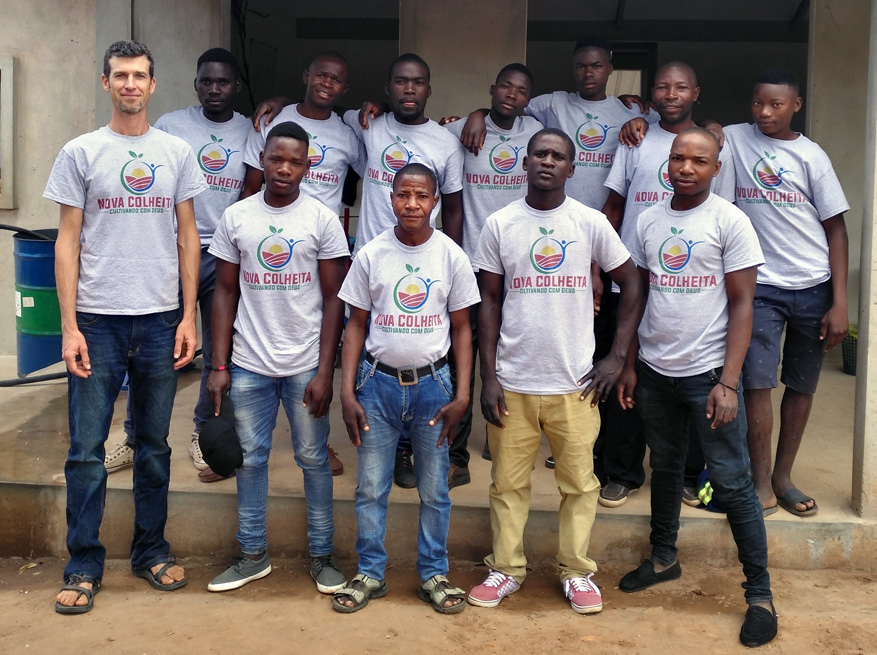
While Chad had been serving in full time ministry since 2003, he grew up on a produce farm in a heavily agricultural based area of Michigan. This agricultural foundation was instrumental in the developing of NHF. NHF was launched from humble beginnings with a team of 3 and a shoestring budget. Even with these humble beginnings, the project saw some early success. Those early gains were put to the test when only 5 months after launch, NHF found itself directly in the path of Cyclone Idai, the deadliest cyclone to ever hit Africa. More than 1000 people lost their lives and the damage from wind and flooding was immense. Over a million acres of farmland were destroyed leaving nearly 2 million people dependent on food aid. While this challenge could have derailed the young NHF, it actually strengthened the staff’s resolve. Despite some damage to fields, NHF’s training center and even the harvest(the cyclone hit just at harvest time) was largely spared. It was a huge testimony to the Lord’s provision and some of the basic agricultural practices that had already been implemented.(such as terracing and row planting) Seeing the fragility of the agricultural system of the region in the wake of the storm reinforced NHF in its purpose. In the months after the storm NHF was able to ramp up it’s own food production as well as provide seeds and basic tools to many small scale farmers who had suffered from the storm. It also sped up NHF’s timeline and only 9 months after breaking ground NHF held its first community agricultural training session. This was 9 months ahead of schedule. The training sessions were well attended as many local farmers found themselves open to new ideas after the large losses of the previous agricultural campaign.
NHF continues to grow and develop as an agricultural training institute. While the corona virus pandemic of 2020 has meant that agricultural training sessions have had to be suspended, development of the institute and training curriculum continues. Despite the many challenges the Lord continues to bless the ministry and we are excited to see how the Lord will use this project.